ISO 27001 and Essential Eight: The Same Controls, Wearing Two Name Tags
22 August 2026 · Compliance365
If your organisation already holds ISO 27001 certification and a customer or government tender now asks for an Essential Eight maturity assessment — or the reverse — the instinct is often to treat it as a second, separate program. In most organisations it isn't. The two frameworks are looking at overlapping technical territory, described in different language, assessed by different mechanisms.
This isn't a "which one first" post — we've covered that decision for ISO 27001 vs SOC 2 already. This is about what happens once you already hold one and get asked for the other.
Two different shapes, describing a lot of the same reality
ISO 27001 is a management-system standard: a certified Information Security Management System covering governance, risk assessment, and a broad Annex A control set — access control, cryptography, physical security, supplier relationships, incident management, and more. It produces a certificate from an accredited body.
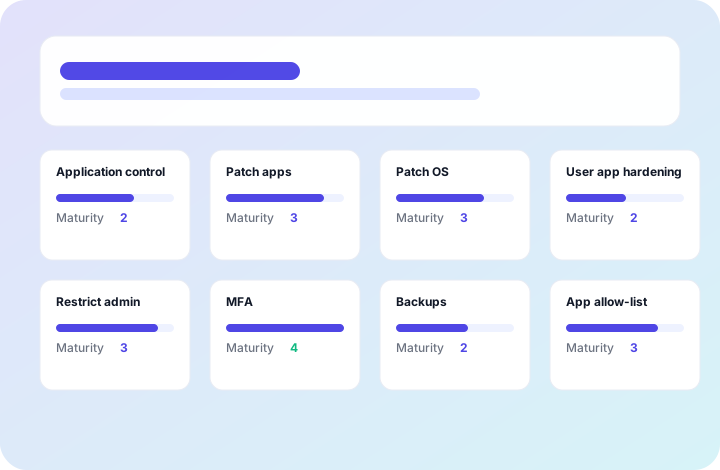
Essential Eight is narrower and more prescriptive: eight specific technical mitigation strategies (application control, patching applications, configuring Microsoft Office macro settings, user application hardening, restricting admin privileges, patching operating systems, multi-factor authentication, and regular backups), each assessed against a maturity level from ML0 to ML3. It’s an Australian Signals Directorate framework, and it’s mandatory for many Australian Government entities and increasingly requested well beyond government.
They are not the same shape — one is a management system, the other a technical control checklist — but a genuinely large share of Essential Eight’s eight strategies map directly onto specific technical expectations already embedded in an ISO 27001 ISMS:
| Essential Eight strategy | The ISO 27001 ground it already covers |
|---|---|
| Multi-factor authentication | Access control and authentication requirements in an ISMS's identity management controls |
| Restrict admin privileges | Privileged access management, a standard ISMS control area |
| Patch applications / patch OS | Technical vulnerability management, expected under any operational-security control set |
| Regular backups | Information backup and business continuity controls |
| Application control, macro settings, user hardening | Secure configuration and malware-protection controls |
The exact control numbering differs between an ISMS’s Annex A structure and Essential Eight’s own maturity indicators, but the underlying question being asked — “is MFA actually enforced,” “is patching actually current,” “are backups actually tested” — is frequently identical, and the technical evidence that answers it is the same evidence either way.
Where they genuinely diverge
ISO 27001 covers supplier risk, physical security, HR security and management review — territory Essential Eight doesn't touch at all.
Essential Eight's maturity levels are more prescriptive and technically specific than ISO 27001's principle-based Annex A wording on the same topic.
A certificate (ISO 27001) versus a self-assessed or independently-assessed maturity level (Essential Eight) — different artefacts for different audiences.
Neither framework substitutes for the other. The point isn’t that they’re interchangeable — it’s that the evidence you’d need to gather for one substantially overlaps with what you’d need for the other, and gathering it twice, independently, from scratch, is the actual waste.
Where the reuse should actually happen
This is exactly the mechanism Checkpoint’s cross-framework propagation is built for: mark a control Implemented under one framework, and Checkpoint checks whether the equivalent control exists under any other framework your tenant carries — and offers to propagate the same status, because it’s the same real-world control wearing two labels, not two separate facts to keep in sync by hand. It deliberately never propagates automatically or silently; a practitioner confirms every suggestion, because “the same control” and “a related but distinct requirement” can look similar and aren’t always the same thing.
Where to start
If you already hold one of these two and have just been asked for the other, the fastest honest first step is a gap assessment against what you can already evidence — not a fresh implementation project. Book a free 30-minute call and we’ll map what genuinely carries over from your existing certification before scoping anything new.
We deliver ISO 27001, Essential Eight, SOC 2, ISO 42001 and ISO 27701 for Australian mid-market organisations — fixed-price, inside your existing Microsoft 365 environment, with one evidence base across every framework you carry. Explore our services →
Found this useful? Get the ISO/Privacy/AI readiness checklists.
Browse resources