NIST CSF 2.0 · Delivered Remotely · Australia · US · UK
NIST CSF 2.0 – Clear, Measurable Cybersecurity
Build a strong, defensible cybersecurity posture that boards, regulators, and customers understand — without complexity or delays.
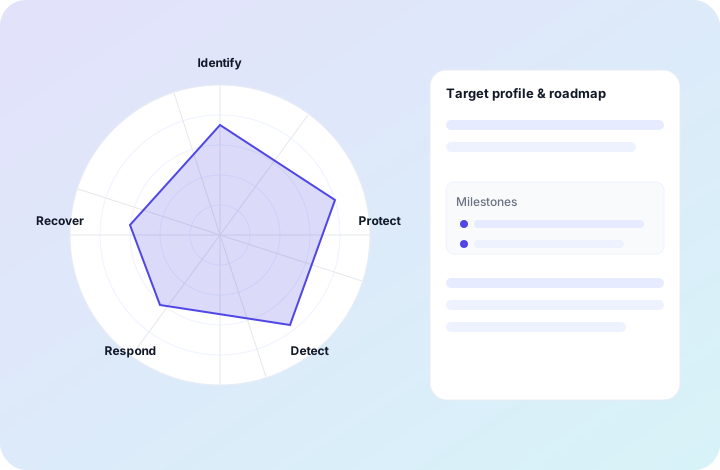
NIST CSF 2.0 gives you a flexible, risk-based framework (Govern, Identify, Protect, Detect, Respond, Recover) to assess where you are, define where you need to be, and show measurable progress. We deliver it fast — so you can focus on growth, not gaps.
- Current → Target
- Prioritized Roadmap
- Measurable KPIs
- Board-Ready
Current Profile assessment from $6k–$12k. Full Current + Target + Roadmap from $12k–$35k. Fixed-price, delivered in 4–8 weeks.
Why NIST CSF 2.0 Matters to Your Business
Boards, regulators, customers and procurement teams want to know your cyber program is effective and improving. NIST CSF 2.0 is the global benchmark that proves it — giving you credibility, clarity, and a path to stronger trust.
Build Executive & Board Confidence
Clear Current & Target Profiles + measurable KPIs — so leadership sees real progress, not just checklists.
Reduce Cyber Risk
Identify and prioritize the biggest gaps — protecting your organisation from breaches, downtime, and reputational damage.
Meet Regulatory & Customer Expectations
Aligns with APRA, ASD, ISO 27001, Essential Eight — and gives buyers the assurance they need to say yes faster.
Cost estimator · NIST CSF
What NIST CSF will cost you
Pick your size and how you want to do it. The ranges come from our published fixed prices, audit fees, Checkpoint licences and day rate, in AUD ex GST.
An estimate, not a quote. Your fixed price is confirmed in a free scoping call before any work starts. The quote button opens our contact form with these choices filled in.
NIST CSF 2.0 in the Australian Regulatory Context
NIST CSF is not legislatively mandated in Australia, but it is referenced in APRA guidance and increasingly expected by boards, government procurement panels, and regulated-sector customers.
APRA CPS 234 and CPG 234
APRA's CPS 234 (Information Security) requires APRA-regulated entities — banks, insurers, superannuation funds — to maintain an information security capability commensurate with the size and extent of threats to their information assets. APRA's CPG 234 guidance explicitly references NIST CSF as an appropriate framework for structuring a security capability assessment. A NIST CSF Current Profile provides the evidence structure that APRA expects regulated entities to demonstrate — and that ICT suppliers to APRA-regulated entities are increasingly asked to provide.
SOCI Act Obligations
The Security of Critical Infrastructure Act 2018 (SOCI Act) imposes positive security obligations on owners and operators of critical infrastructure assets across 11 sectors — including energy, water, transport, communications, financial services, data storage, and defence industry. NIST CSF maps directly to SOCI Act risk management programme requirements. Organisations subject to SOCI Act obligations use NIST CSF Current and Target Profiles to demonstrate that their risk management programme meets the standard expected by the Australian Cyber Security Centre (ACSC).
NIST CSF vs ISO 27001 vs Essential Eight
These frameworks are complementary, not competing. ISO 27001 provides a certifiable management system — the audited evidence framework that procurement and legal teams need. Essential Eight provides prescriptive technical controls for government-adjacent and critical infrastructure environments. NIST CSF provides the posture measurement and board-reporting layer that sits above both — letting you communicate where you stand across all your framework obligations in a single coherent view. Most organisations pursuing ISO 27001 or Essential Eight benefit from a NIST CSF overlay to translate technical compliance into board-level risk language.
Board and Executive Reporting
ASIC's guidance on cyber risk governance and the ASX Corporate Governance Principles both emphasise that boards are expected to understand and oversee the organisation's cyber risk posture. NIST CSF provides the standard vocabulary for this conversation — Current Tier, Target Tier, gap analysis, and a prioritised roadmap. A NIST CSF posture scorecard gives your board the quarterly update they need without requiring them to understand specific technical controls. For ASX-listed companies and large private organisations, this board-ready reporting structure is increasingly a governance expectation rather than an optional extra.
NIST CSF in its home market
NIST CSF is maintained by the US National Institute of Standards and Technology, and it shows — it's the default "common language" framework requested in US vendor risk questionnaires and cyber insurance applications, whether or not the requesting organisation is itself US-based.
The default vendor risk questionnaire language
US enterprise procurement and vendor risk teams overwhelmingly frame their security questions around NIST CSF's five functions — Identify, Protect, Detect, Respond, Recover — even when they don't name the framework explicitly. A NIST CSF Current Profile gives you a ready answer in the exact vocabulary the questionnaire is already using, instead of translating your ISO 27001 or SOC 2 evidence into unfamiliar terms on the fly.
Cyber insurance and board reporting
US cyber insurers increasingly reference NIST CSF tiers in underwriting questionnaires, and it's the framework most US boards already have some familiarity with from public company cybersecurity discourse. A NIST CSF overlay on top of ISO 27001 or SOC 2 work you've already done gives US-facing boards and insurers the reporting structure they expect, without a separate assessment.
Common Cybersecurity Fears We Solve
We help teams overcome the same concerns — unclear posture, board pressure, regulatory questions, and fear of falling behind.
“We don't know where we stand”
We create a clear Current Profile — so you see exactly where you are strong and where the real risks lie.
“The board wants metrics”
Simple, board-ready KPIs and posture scorecards — showing progress quarter after quarter.
“Regulators/customers keep asking”
Ready-to-share profiles, roadmaps and evidence — so you answer confidently and move forward faster.
The Six Core Functions of NIST CSF 2.0
NIST CSF 2.0 organises cybersecurity into six functions — each with clear outcomes that matter to your business.
Govern
Set direction, roles, policies and oversight — so cybersecurity supports your strategy and meets board/regulatory expectations.
Identify
Know your assets, risks, and dependencies — so you can focus resources on what matters most.
Protect
Implement safeguards — access controls, training, data security — to prevent incidents.
Detect
Continuously monitor for threats — so you catch anomalies early and respond before damage.
Respond
Have tested plans and processes — so you contain and recover from incidents quickly.
Recover
Restore operations and learn from incidents — so you bounce back stronger.
What You Get with NIST CSF 2.0 Support
Current Profile
Clear, evidence-based view of your current cybersecurity posture across all six functions. On Checkpoint, 8 of the 22 categories — the ones with a genuine live signal — get their status proposed automatically from a Microsoft 365 posture scan, confirm or dismiss.
Target Profile & Roadmap
Prioritized 12-month plan — quarterly milestones, owners, dependencies, and budget lens.
Measurable KPIs & Scorecard
Board-level metrics and posture dashboard — so progress is visible and defensible.
Cross-Mappings
Alignments to ISO 27001, Essential Eight, SOC 2 — reduce duplication and audit fatigue.
Typical NIST CSF 2.0 Timeline
Fast, focused, and built around your real risks — not theory.
Weeks 1–4
Current Profile assessment
Weeks 5–10
Target Profile & prioritized roadmap
Weeks 11–12
KPIs, scorecard & board reporting setup
Ongoing
Quarterly reviews & continuous improvement
What NIST CSF looks like in Checkpoint
Your NIST CSF engagement is tracked in Checkpoint across all six functions: each category's status, owner and evidence, and the ISO 27001, Essential Eight and SOC 2 controls it also satisfies.
NIST CSF 2.0 in Checkpoint
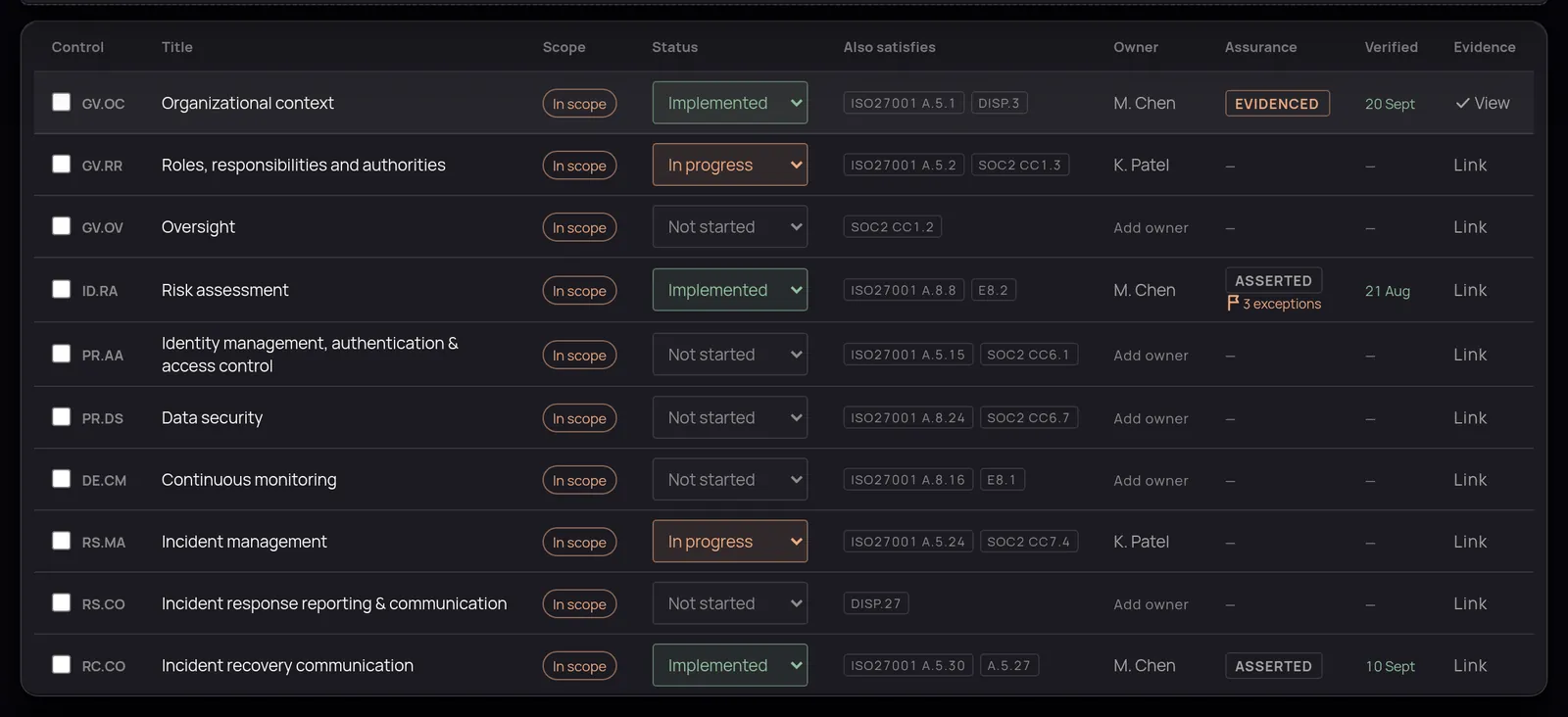
NIST CSF's categories are broad enough that a scan catches a live signal for over a third of them — a higher automated fraction than SOC 2 or ISO 42001's more granular controls.
NIST CSF 2.0 FAQs
What is NIST CSF 2.0?
A flexible, risk-based cybersecurity framework with six core functions: Govern, Identify, Protect, Detect, Respond, and Recover. It doesn't replace ISO 27001 or Essential Eight — it gives you a structured way to measure your posture against them and communicate progress to boards and regulators.
How long does it take and what does it cost?
Current Profile assessment: 2–4 weeks, from $6k–$12k fixed-price. Full Current + Target Profile + Roadmap: 4–8 weeks, from $12k–$35k. Ongoing quarterly measurement cadence is available at preferential rates for existing clients.
How does NIST CSF relate to ISO 27001 and Essential Eight?
NIST CSF maps directly to both. For organisations already holding ISO 27001 or pursuing Essential Eight ML2, a NIST CSF Current Profile is a fast way to produce board-level posture visibility without rebuilding controls. For organisations earlier in the journey, NIST CSF is an effective first step before committing to a certification programme.
Can you help with board reporting or regulatory questions?
Yes. We produce board-ready posture scorecards, KPI dashboards, and framework cross-mappings (NIST CSF to ISO 27001, Essential Eight, SOCI Act) designed to answer the question "where do we stand and what are we doing about it?" without requiring your board to understand the framework.
Is NIST CSF mandatory in Australia?
Not legislatively, but it is referenced in APRA CPG 234 guidance and increasingly recognised in government-adjacent procurement. For organisations already required to align with ISO 27001, Essential Eight, or SOCI Act obligations, NIST CSF is often the fastest way to produce a unified posture view across all requirements.
What's the difference between a Current Profile and a Target Profile?
The Current Profile documents where your cybersecurity posture sits right now — assessed against the six CSF functions and their sub-categories. The Target Profile defines where you need to be, based on your risk appetite, regulatory obligations, and business objectives. The gap between them becomes your prioritised roadmap. Most engagements deliver both together.
Related Services
Build on NIST CSF 2.0 with security, privacy, AI governance or other frameworks — all aligned.
Keep reading — NIST CSF
Guides, checklists and case studies
Get a realistic scope in 30 seconds
Three questions. Instant estimate including the third-party platform licence costs you'll avoid. No sign-up.
Estimate based on typical engagement patterns. Precise scope confirmed on call after reviewing your environment.
Free monthly digest
Get the monthly Australian compliance digest
Practical updates on ISO 27001, Essential Eight, Privacy Act and AI governance — delivered once a month. No spam, unsubscribe any time.
Ready to Strengthen Your Cyber Posture?
Book a free 30-minute call — we'll show you how to build NIST CSF 2.0 profiles, roadmaps, and measurable outcomes that give your board and customers confidence.
Most teams build strong posture visibility in under 12 weeks.