SOC 2 · Delivered Remotely · Australia · US · UK
SOC 2 readiness — honest about timelines, ruthless about evidence.
If your enterprise deals are stuck behind "we need SOC 2 first," we deliver readiness in 8–12 weeks — inside your existing Microsoft 365 and cloud environment, on Checkpoint, our own console included in the engagement. No Vanta, no Drata, no annual third-party platform licence. And no pretending Type II takes 12 weeks when it doesn't.
- 8–12 weeks to readiness
- Type I & Type II
- M365 + cloud native
- $0 third-party platform fees
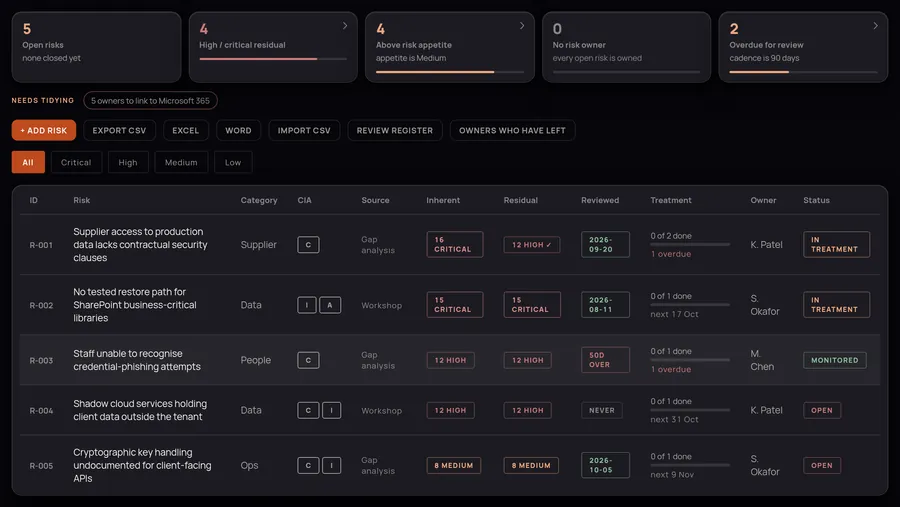
The Type II observation period — what most consultants won't tell you.
SOC 2 has a structural reality that's frequently misrepresented in sales pitches. Understanding it upfront saves you from a confused conversation with procurement six weeks into the engagement.
SOC 2 Type I
Design assurance
A point-in-time report that says your controls are designed properly. The auditor reviews your control set and confirms it would work if operated.
- Faster — readiness in 8–12 weeks
- Useful for early enterprise sales conversations
- Rarely sufficient on its own for procurement gates
- Audit fees typically $10k–$30k
Report available:
~Week 14
SOC 2 Type II
Operating effectiveness
A report that says your controls actually worked across a continuous observation window. This is what enterprise procurement actually wants when they say "SOC 2".
- Requires 3–12 month observation period after readiness
- Evidence captured continuously during that window
- The standard for enterprise procurement gates
- Audit fees typically $20k–$60k
Report available:
~Month 8
Most clients pursue both: Type I at week 14 for early sales conversations, then Type II at month 8 once observation completes. We build the readiness infrastructure once — same controls, same evidence pipeline, two reports.
Cost estimator · SOC 2
What SOC 2 will cost you
Pick your size and how you want to do it. The ranges come from our published fixed prices, audit fees, Checkpoint licences and day rate, in AUD ex GST.
An estimate, not a quote. Your fixed price is confirmed in a free scoping call before any work starts. The quote button opens our contact form with these choices filled in.
Which Trust Services Criteria do you actually need?
SOC 2 has five Trust Services Criteria. Security is mandatory; the other four are added based on what your customers require. Over-scoping is a common and expensive mistake.
Mandatory
Security (Common Criteria)
Access controls, change management, vulnerability management, incident response, system monitoring. Every SOC 2 report includes this. About 50 individual control points across nine common criteria areas.
Common add
Availability
Uptime SLAs, capacity monitoring, disaster recovery, backup testing. Add this if your customers have uptime requirements in their contracts — typical for fintech, healthcare, and infrastructure SaaS.
Common add
Confidentiality
Information classification, encryption, secure data sharing, retention and disposal. Add this if you handle commercially sensitive data — most B2B SaaS does. Often paired with Security as the default starting scope.
Conditional
Processing Integrity
Input validation, processing accuracy, completeness, error handling. Add this if your service performs financial calculations, transaction processing, or any computation where accuracy is the product itself.
Conditional
Privacy
Personal information notice, consent, retention, data subject rights. Add this if you process significant personal data — but consider ISO 27701 alongside, which is often a better framework for the privacy-specific work.
Most common scope
Security + Confidentiality
About 70% of our SOC 2 clients start with this combination. Sufficient for most enterprise procurement gates without over-scoping. Easy to add additional TSCs in subsequent annual audits if customer needs evolve.
What's included in the engagement
Every SOC 2 readiness engagement covers these six areas. We build the infrastructure once — it serves both Type I and Type II without duplication.
Scoping & system description
We define the system boundary, identify Trust Services Criteria in scope, and draft the system description the auditor will review. Getting this right upfront saves expensive scope discussions during the audit itself.
Control framework & mapping
Every applicable common criteria and TSC point mapped to a specific control in your environment. Where controls don't exist yet, we design them. Where they exist informally, we formalise and document them.
Policy suite
Information security, access control, change management, incident response, vendor management, business continuity. Written specifically for your environment, approved through your governance, mapped to the controls they support.
Evidence capture pipeline
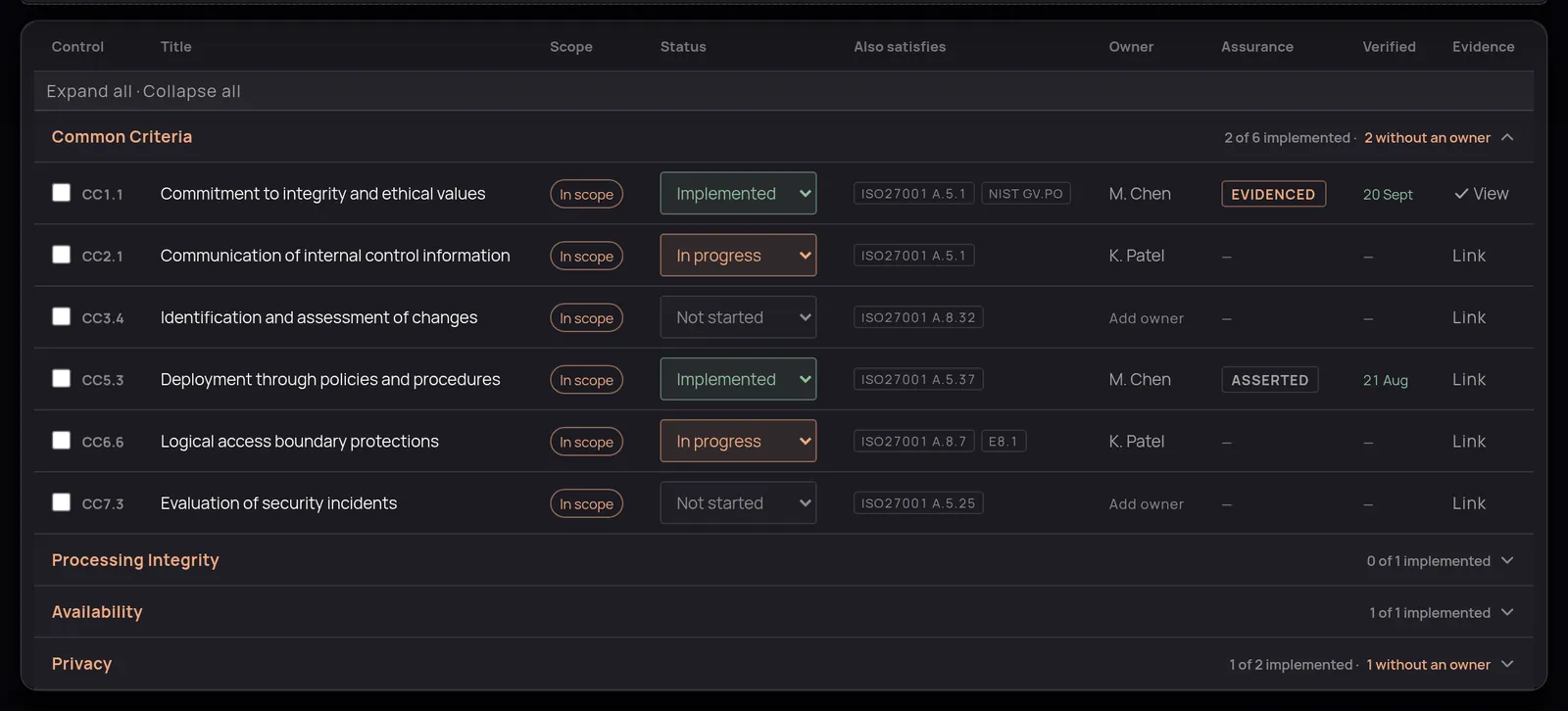
The crucial Type II infrastructure. Automated evidence flowing from M365 audit logs, your cloud provider's logs, your CI/CD pipeline, your ticketing system — into a SharePoint evidence library mapped control-by-control. Built once, runs continuously. On Checkpoint, a posture scan goes further for 13 Trust Services Criteria — the CC6.x access-control and CC7.x monitoring series — and proposes the control's status directly, not just its evidence. You confirm or dismiss every suggestion. Switch the SoA to Type II and it shows the actual observation window per control — how many scans, and whether any of them found an exception — not just whether it's designed correctly today.
PBC (Provided by Client) preparation
Your auditor will send a list of evidence requests — the PBC list. We pre-populate it, structure responses, and coach your team for walkthroughs. Auditors notice when a client is prepared, and it shortens the audit timeline materially.
Auditor support throughout
We work with your chosen CPA firm — coordinating timing, responding to sample requests, addressing observations as they arise, drafting management responses to any findings. You're not navigating the auditor relationship alone.
What the evidence looks like
The Type II observation period requires continuous, automated evidence capture. Here's what that looks like in Checkpoint: each Trust Services Criterion with its status, owner, assurance and evidence, and the posture scan that re-checks your Microsoft 365 settings.
SOC 2 criteria, status and evidence
Posture scan of your Microsoft 365
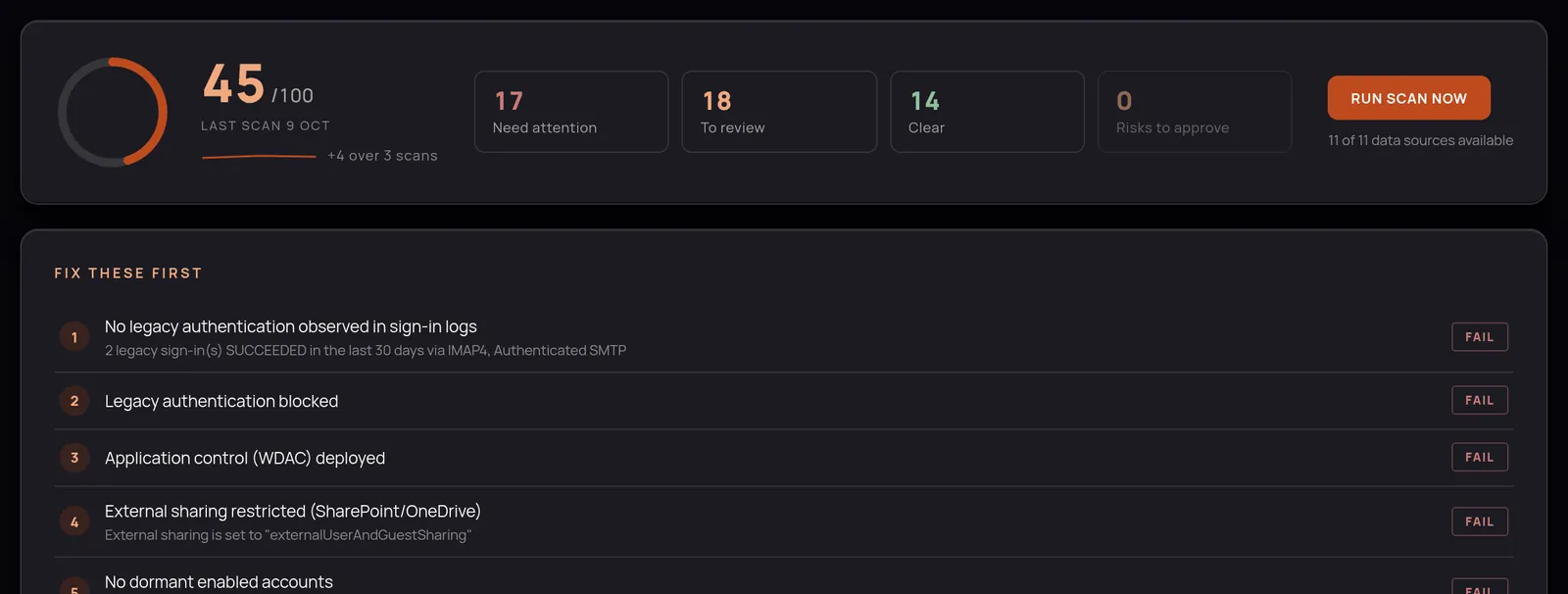
13 Trust Services Criteria — the ones with a genuine live signal — get their status proposed automatically from the posture scan. The COSO-derived governance criteria, availability commitments, and most Privacy and Processing Integrity criteria, need a human either way and stay self-reported.
Choosing your auditor
SOC 2 reports are issued by AICPA-licensed CPA firms, not certification bodies. This is different from ISO certifications and often confuses Australian SaaS companies. Three things to know.
You choose the auditor, not us
We don't take referral fees and we don't have a preferred auditor relationship that compromises our independence. We help you evaluate options (Australian firms with US audit licences, US firms with Australian presence, smaller specialised SOC 2 auditors) based on your situation and budget.
Audit fees vary 3–4x
Big 4 firms charge premium rates ($60k–$200k for Type II). Mid-tier firms often charge $40k–$80k. Specialised SOC 2-focused firms can be $20k–$50k for Type II. All produce the same report. The right choice depends on which name your enterprise customer wants to see on the report.
Audit timing affects observation window
Auditors book 3–6 months in advance. Booking the auditor *before* completing readiness is a common rookie mistake — it forces you to be ready by their date rather than yours. We coordinate timing so your readiness completes before observation starts, and observation completes before audit fieldwork.
SOC 2 for US-facing companies — what's different
SOC 2 is a US-origin standard, so a US buyer's expectations shape more of the engagement than the standard itself does. A few things that specifically matter if your customers or investors are American.
US state privacy law alignment
The Privacy Trust Services Criterion maps directly to CCPA/CPRA and the growing patchwork of US state privacy laws. Companies handling data from California, Colorado, Virginia or other regulated states add Privacy to their SOC 2 scope to get one evidence set covering both, instead of a separate privacy programme.
Type II is the real gatekeeper
US mid-market and enterprise procurement teams increasingly ask for SOC 2 Type II specifically, not Type I — a security questionnaire that used to take a few weeks to clear now often stalls entirely without it. We scope the observation window around your actual sales pipeline, not a generic template.
Delivered remotely, no US office required
SOC 2 evidence lives in your Microsoft 365 tenant and cloud environment, not in a physical office — remote delivery works the same for a San Francisco SaaS company as it does locally. Fixed price, coordinated across time zones for calls and evidence reviews.
Healthcare & fintech overlap
For healthcare SaaS handling PHI or fintech companies under state financial regulations, SOC 2's Confidentiality and Availability criteria provide the evidence structure regulators and enterprise customers expect alongside HIPAA safeguards — one evidence set, not two parallel programmes.
Who this is for
SOC 2 is the right framework for Australian organisations in one of these situations. We're based in Brisbane and work with SaaS and technology companies across Queensland, New South Wales, Victoria, and nationally.
Enterprise deals stuck behind procurement
You have one or more enterprise prospects who've explicitly asked for SOC 2 in tenders, security questionnaires, or contract clauses. The deal is otherwise ready to close. This is the most common SOC 2 trigger we see.
You sell SaaS into the US market
SOC 2 is the dominant security framework for US enterprise procurement. Even Australian SaaS companies selling into the US face SOC 2 questionnaires before ISO 27001 ones. If US revenue is a significant slice of your pipeline, SOC 2 is non-negotiable.
You're a series B+ SaaS company
VC-backed SaaS companies typically hit SOC 2 readiness pressure around series B. Customers get larger, deal sizes grow, procurement gates tighten. Implementing SOC 2 here is cheaper than waiting until series C when you're answering 50 customer security questionnaires a year.
You already have ISO 27001
About 75% of SOC 2 controls overlap with ISO 27001. If you're already certified, adding SOC 2 is significantly cheaper than starting from scratch. Most engagements deliver SOC 2 in 6–8 weeks for ISO 27001-certified clients.
Common questions
Answered plainly. If you have a question not covered here, the fastest way to get a real answer is a 30-min call.
How long does it actually take?
Type I: 8–12 weeks to readiness, ~2 weeks of audit, report at week 14. Type II: 8–12 weeks to readiness, then 3–6 months observation, then 4–6 weeks audit, report around month 8. We're upfront about this because most consultants aren't.
What does readiness cost?
Fixed-price, $22k–$115k depending on company size. Includes Type I support and the evidence infrastructure for Type II. Audit firm fees ($10k–$30k for Type I, $20k–$60k for Type II) are separate and paid directly to your auditor.
Type I or Type II first?
Type I gets you something to show in ~14 weeks but rarely satisfies procurement on its own. Type II is what enterprise customers actually want. Most clients do both: Type I early for sales conversations, Type II at month 8 for the real deal.
Which TSCs do we need?
Security is mandatory. Confidentiality is added by ~70% of clients. Availability, Processing Integrity, and Privacy are added based on customer-specific requirements. Over-scoping is the most common expensive mistake — we scope to what your deals actually need.
Do we need Vanta or Drata?
No. We build entirely inside your existing M365 and cloud environments, on Checkpoint — included in the engagement. Over a 3-year cycle this saves $45k–$180k in avoided platform licence costs versus the third-party GRC platform approach.
Can we combine SOC 2 with ISO 27001?
Yes — about 75% of controls overlap. Combined engagements typically deliver both for 30–40% less than sequential programmes. The output is a single control set with two reports: SOC 2 Type II for US-facing sales, ISO 27001 for AU/EU government and enterprise.
What is a PBC list?
PBC stands for "Provided by Client" — it's the list of documents, screenshots, exports, and records your auditor requests as evidence during the audit. For a typical SOC 2 Type II audit, this runs to 40–120 items. Because we build your evidence infrastructure before the audit begins, most PBC items are already indexed and retrievable in minutes rather than days. We prepare your team for exactly what the auditor will ask for before they ask.
What happens in year 2 and beyond?
SOC 2 Type II reports are typically renewed annually. Year 2 is a continuation of the observation period — the same controls, the same evidence cadence, a new 12-month window. Because evidence collection is automated and continuous, the year 2 audit is materially less effort than year 1. Existing clients get preferential rates on ongoing evidence maintenance and audit support — we'd rather earn the next three years than bill you for a fresh programme every cycle.
Real SOC 2 results
How a Melbourne network provider ran ISO 27001 and SOC 2 Type II in parallel — and won both US and Australian enterprise contracts.
Related frameworks
SOC 2 often pairs with ISO 27001 for global procurement coverage, or with ISO 27701 / ISO 42001 for privacy and AI governance.
Keep reading — SOC 2
Guides, checklists and case studies
Get a realistic scope in 30 seconds
Three questions. Instant estimate including the third-party platform licence costs you'll avoid. No sign-up.
Estimate based on typical engagement patterns. Precise scope confirmed on call after reviewing your environment.
Free monthly digest
Get the monthly Australian compliance digest
Practical updates on ISO 27001, Essential Eight, Privacy Act and AI governance — delivered once a month. No spam, unsubscribe any time.
Got an enterprise deal stuck behind SOC 2?
A free 30-minute call will scope a realistic SOC 2 plan against your actual sales situation. What you need, when you'd have it, what it would cost. No sales pitch. If Type I is enough to unblock the deal, we'll say so.