SOC 2 Certification Timeline for Australian SaaS — Microsoft 365 Guide
2 November 2025 · Compliance365
SOC 2 certification demonstrates to customers and partners that your organisation’s controls are secure, available, and confidential—and that they operate effectively over time.
For Australian SaaS providers, the hardest part is not writing policies but proving compliance repeatedly and consistently.
This guide outlines how to achieve SOC 2 Type 1 and Type 2 readiness faster by automating evidence directly within Microsoft 365, Azure, GitHub, and Azure DevOps—the systems your teams already use every day.
Why Australian SaaS Companies Pursue SOC 2
SOC 2 originated in the US market — it’s a standard issued by the American Institute of Certified Public Accountants (AICPA) and evaluated by US-registered CPA firms. So why are Australian SaaS companies pursuing it?
Three reasons drive almost every Australian SOC 2 engagement:
- US enterprise sales. If your SaaS product is selling to US enterprise customers — particularly in financial services, healthcare, or technology — you will be asked for a SOC 2 Type II report as a condition of procurement. ISO 27001 is not an accepted substitute in most US enterprise security review processes.
- Enterprise procurement in Australia. Large Australian enterprises, ASX-listed companies, and financial institutions increasingly include SOC 2 or ISO 27001 requirements in their technology vendor risk questionnaires. Both frameworks are now expected rather than exceptional in mid-market SaaS deals.
- Combined certification. Many Australian SaaS companies pursue ISO 27001 for the domestic and international market, and SOC 2 for US enterprise simultaneously. Because the frameworks overlap significantly on security controls, doing them together costs 30–40% less than sequentially.
What SOC 2 does not do: SOC 2 is not a substitute for Privacy Act compliance. If your SaaS platform processes personal information of Australian individuals, the Privacy Act 1988 and its 13 Australian Privacy Principles apply regardless of whether you hold a SOC 2 report. ISO 27701 covers the privacy management gap — and is increasingly pursued alongside SOC 2 by Australian SaaS companies selling to privacy-conscious customers.
1 Define a Practical SOC 2 Scope
Start small and realistic.
- System Boundary: Identify the product or service in scope, data flows, hosting platforms, and key third-party providers.
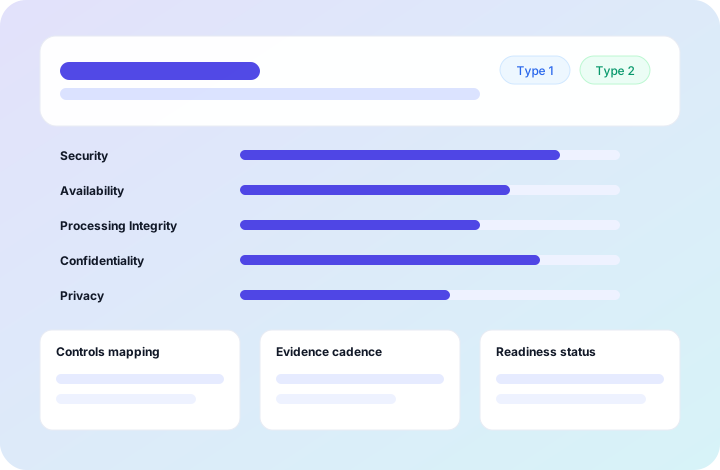
- Trust Services Criteria (TSC): Always include Security. Add Availability and Confidentiality when customer contracts or market expectations require them.
- System Description: Keep it factual and concise—a living narrative of how your platform actually works.
Tip: The clearer your system description, the easier the audit and future updates.
2 Align Controls With How You Work
| Area | Evidence Source | Typical Controls |
|---|---|---|
| Access Management | Entra ID / Azure AD | Role-based access, MFA enforcement, SSO inventory |
| Change Management | GitHub / Azure DevOps | PR reviews, build scans, pipeline approvals |
| Vendor Governance | SharePoint / Contracts | SOC reports, DPAs, SLAs, renewal tracking |
| Logging & Monitoring | Microsoft Defender / Sentinel | Alert rules, incident tickets, SLA evidence |
When controls mirror daily operations, compliance stops feeling like an add-on and becomes part of your normal workflow.
3 Automate Evidence Collection
Automation removes friction and ensures consistency.
- Scheduled Exports → SharePoint (with versioning & retention)
- Privileged-role membership
- MFA / Conditional Access settings
- Build and PR status reports
- Sentinel incidents and response SLAs
- Timed Screenshots: For artefacts without APIs—capture who, when, and why.
Outcome: a repeatable, timestamped evidence trail aligned to auditor sampling periods.
4 Type 1 vs Type 2 — Choose Your Path
| Type | Purpose | Duration | Best For |
|---|---|---|---|
| Type 1 | Point-in-time design validation | 4–8 weeks | Start-ups or early sales assurance |
| Type 2 | Ongoing operating effectiveness | 3–12 months | Established SaaS scaling to enterprise |
Recommended approach: Begin with Type 1 to confirm your control design, then move seamlessly into a Type 2 evidence cadence (monthly or quarterly).
5 Typical SOC 2 Readiness Timeline
| Phase | Weeks | Key Deliverables |
|---|---|---|
| Plan & Scope | 1–2 | Boundary definition, TSC mapping, system description |
| Build & Integrate | 3–6 | Control implementation, automated evidence flows |
| Readiness Review / Type 1 Audit | 7–8 | Formal readiness report or Type 2 period kick-off |
Most SaaS teams leveraging Microsoft 365 and Azure can reach SOC 2 Type 1 readiness within eight weeks.
6 Common Pitfalls to Avoid
- Evidence scattered across local drives or emails
- Controls written differently from how engineering actually works
- No single repository for auditors to sample from
- Manual screenshots without version history or ownership
7 Next Steps
Found this useful? Get the ISO/Privacy/AI readiness checklists.
Browse resources