ISO 27701 · Privacy · Delivered Remotely · Australia · US · UK
Add ISO 27701 privacy on top of your ISMS — in weeks, not months.
ISO 27701 extends ISO 27001 with privacy-specific controls. Same management system, same evidence pipeline, same audit cycle — with DPIAs (privacy impact assessments), ROPAs (records of processing activities), rights handling, and third-party privacy management layered on top. For organisations already ISO 27001 certified, we deliver it in 6–10 weeks.
- 6–10 weeks
- Built on ISO 27001
- ~40% less work
- Privacy Act aligned
The Privacy Act reform changes the maths.
Privacy used to be a "nice to have" alongside security. The Privacy Act amendments rolling out through 2026 change that. Three specific shifts your board should understand.
Penalties up to $50m per breach
The maximum penalty for serious or repeated privacy breaches is now the greater of $50m, three times the benefit derived, or 30% of adjusted turnover. The OAIC has clearly signalled it intends to use these powers. "We didn't know" is no longer a defence.
Statutory tort for serious invasions
A new statutory cause of action allows individuals to sue directly for serious invasions of privacy — without proving financial loss. This shifts privacy from a regulatory exposure to a civil litigation exposure, and the ones bringing the claims are plaintiff law firms, not regulators.
Mandatory PIAs for high-risk processing
Privacy Impact Assessments are becoming mandatory for high-risk processing activities — AI-enabled decision making, biometric processing, large-scale data analytics. Without a structured PIA process you're either non-compliant or relying on ad-hoc judgement that won't survive scrutiny.
ISO 27701 is the most efficient framework for responding to all three pressures at once — and the only one that integrates cleanly with the security work you've already done.
Cost estimator · ISO 27701
What ISO 27701 will cost you
Pick your size and how you want to do it. The ranges come from our published fixed prices, audit fees, Checkpoint licences and day rate, in AUD ex GST.
An estimate, not a quote. Your fixed price is confirmed in a free scoping call before any work starts. The quote button opens our contact form with these choices filled in.
The same pressure, different regulators
Privacy law is territorial — GDPR, CCPA and the Privacy Act each have their own mechanics — but the underlying ask is the same: know what personal data you hold, why, and be able to prove it. ISO 27701 is built to answer all three from one evidence set.
UK & EU: GDPR
ISO 27701 was designed with GDPR in mind — its controls map directly onto GDPR's Article 5 principles, Article 30 records of processing, and Article 35 DPIA requirements. It's widely recognised by EU and UK regulators as demonstrable evidence of "appropriate technical and organisational measures," and it's the fastest path to a defensible answer if a UK or EU customer's due diligence asks for it directly.
US: CCPA/CPRA and the state patchwork
There's no single US federal privacy law — instead a growing patchwork of state laws (CCPA/CPRA in California, and similar laws in Colorado, Virginia, and others) with overlapping but not identical requirements. ISO 27701's structured approach to data mapping, rights handling and vendor management gives you one system to maintain instead of tracking each state's requirements separately.
Why we build ISO 27701 on top of ISO 27001 — not as a separate project.
Most consultants treat privacy as a separate engagement from security. That doubles the work, doubles the audit overhead, and creates two parallel management systems your team has to maintain. ISO 27701 was designed to avoid this — we build the way the standard intends.
Common path
Privacy as a separate project
- Separate privacy risk register
- Separate privacy policy framework
- Separate evidence pack and audit cycle
- Two management systems to maintain
- Often a different consulting firm
- 12–16 weeks even with ISO 27001 in place
Result:
Privacy bolt-on
Our approach
Integrated management system
- One risk register, security + privacy risks together
- Policies extended with privacy clauses
- One evidence pack, mapped to both standards
- One audit cycle, two certifications
- Same senior practitioner throughout
- 6–10 weeks to add PIMS to existing ISMS
Result:
~40% less total work
What's included in the engagement
Every ISO 27701 engagement covers these six areas, mapped to your existing ISO 27001 management system where one exists.
ROPA & data lifecycle
A complete Record of Processing Activities — every personal data flow mapped with purpose, legal basis, retention, recipients, and Controller/Processor role. Built in SharePoint with automated retention and deletion workflows. The artefact procurement actually asks for.
DPIA framework
Privacy Impact Assessment methodology: screening triggers, full DPIA templates, routing and approval workflows, residual risk sign-off. Embedded in your daily processes — not a Word template no one fills out.
Data subject rights handling
Workflows for access, correction, erasure, restriction, objection, and portability requests. Tracked end-to-end with SLA monitoring. Evidence pack ready for OAIC enquiries or customer audits.
Third-party privacy management
Due diligence framework for new vendors, Data Processing Agreements (DPAs), sub-processor approval workflows, ongoing third-party monitoring, and breach notification clauses. Where most privacy programmes fall apart — and where ours holds together.
Privacy training & awareness
Role-based privacy training delivered via Viva Learning or your existing platform. Onboarding modules, annual refreshers, evidenced completion. Auditors expect to see this — most organisations don't have it.
Audit-ready evidence pack
Every ISO 27701 control mapped to its evidence artefact in SharePoint. Privacy-specific dashboards in Power BI. Generated on demand for OAIC enquiries, customer privacy questionnaires, and external audits. Same infrastructure as your ISO 27001 evidence. On Checkpoint, a posture scan proposes Statement of Applicability status for the PIMS controls with a genuine technical signal — data-in-transit protection for PII, logging of third-party disclosures, processor due diligence — confirm or dismiss, nothing writes itself. Most of PIMS is consent, data-subject rights and cross-border legal basis, which stay self-reported by design; there's no honest technical proxy for those.
Controller, Processor, or both?
ISO 27701 separates privacy responsibilities into two roles. Most organisations are both — Controller for their own data, Processor for data they handle on customers' behalf. The obligations are different, and most consultancies get this confused.
Role 1
Controller
You decide why and how personal data is collected and used. Examples: your own employee records, customer accounts, marketing databases, supplier contacts.
Your obligations:
- Transparency (privacy notices, consent management)
- Lawful basis for processing
- Honouring data subject rights requests
- Conducting DPIAs for high-risk processing
- Overseeing third-party Processors acting for you
Role 2
Processor
You handle personal data on behalf of a Controller. Examples: SaaS hosting customer data, payroll services, managed services delivering to a client.
Your obligations:
- Process only as documented and instructed
- Maintain confidentiality and security
- Get Controller approval before using sub-processors
- Assist Controllers with rights requests and breach notifications
- Maintain records of processing activities
Part of the engagement is mapping every personal data flow in your ROPA and assigning the correct role. This is the foundation everything else builds on — most privacy programmes fail because this mapping was done sloppily or not at all.
Who this is for
ISO 27701 is the right framework for Australian organisations in one of these situations:
You're already ISO 27001 certified
You have an ISMS, you have audit discipline, you have a senior practitioner relationship. Adding ISO 27701 on top is significantly cheaper and faster than starting from scratch — and consolidates your management system rather than fragmenting it.
You handle large volumes of personal data
Healthcare SaaS, fintech, edtech, HR-tech, marketing platforms. Your customers want evidence that personal data is governed properly. ISO 27701 is the credible structured answer that satisfies enterprise and government procurement.
You're exposed to the Privacy Act reforms
The penalty increases, statutory tort, and mandatory PIA obligations rolling out through 2026 raise the cost of inadequate privacy governance. ISO 27701 is the most defensible framework for showing you took it seriously before something went wrong.
You sell into GDPR jurisdictions
ISO 27701 maps closely to GDPR requirements. For Australian organisations supplying European customers, ISO 27701 is the most efficient way to demonstrate GDPR alignment without separate parallel certification.
What your deliverables look like
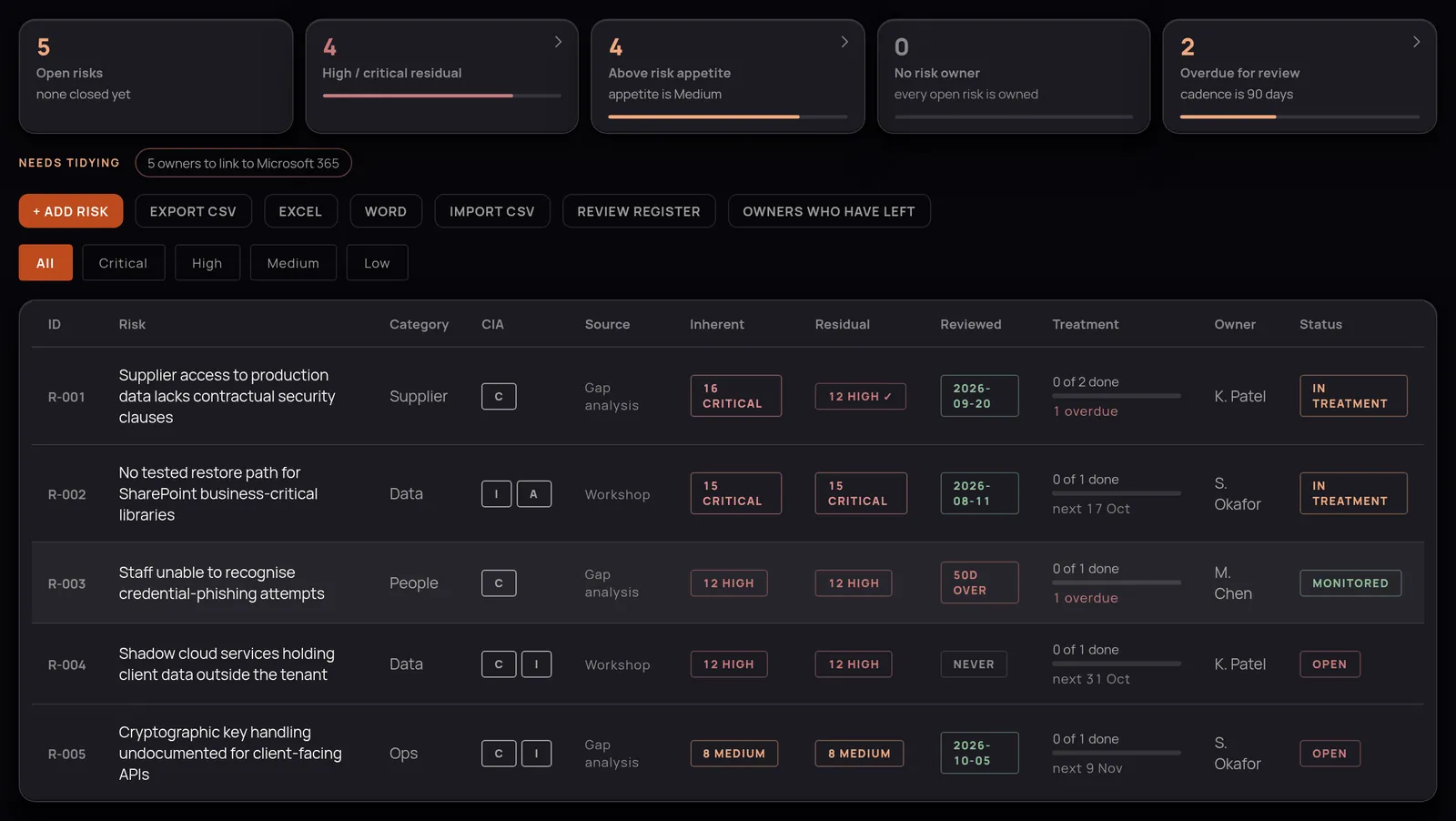
Your Privacy Information Management System lives inside Microsoft 365 — not a separate platform. Here's what the Risk Register and the PIMS Statement of Applicability look like in Checkpoint, which keeps them as SharePoint lists in your own tenant.
Risk register
Statement of Applicability — ISO 27701
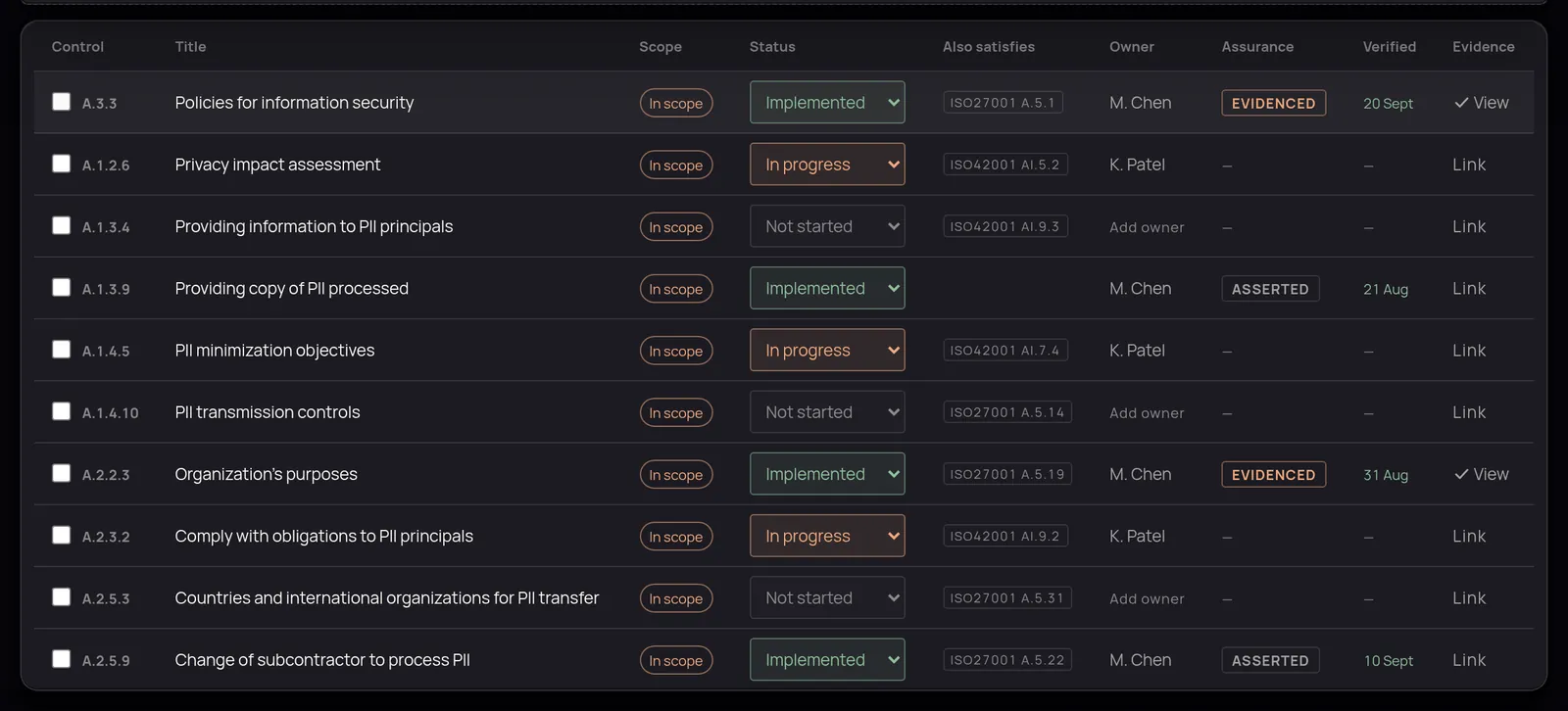
A handful of the controls above are proposed automatically from a Checkpoint posture scan — data-in-transit protection, third-party disclosure logging, processor due diligence. Consent, data-subject requests and cross-border transfer basis need a human either way, so they stay self-reported.
A typical 8-week extension
For organisations already holding ISO 27001 certification. Combined ISO 27001 + ISO 27701 from scratch typically takes 14–18 weeks.
Weeks 1–2
Privacy scope
Personal data audit across the organisation. Initial ROPA mapping. Controller/Processor analysis. Gap assessment against ISO 27701 clauses.
Weeks 3–5
Build
Full ROPA, DPIA framework, rights handling workflows, third-party privacy management, training rollout. Extend ISO 27001 policies with privacy clauses.
Weeks 6–7
Evidence & audit
Evidence pack mapped to both ISO 27001 and ISO 27701 controls. Internal privacy audit. Dress rehearsal for external audit.
Week 8+
Certify
External certification audit. Single audit cycle covering both standards. Certificate issued on successful completion.
Common questions
Answered plainly. If you have a question not covered here, the fastest way to get a real answer is a 30-min call.
Can we do ISO 27701 without ISO 27001?
Yes. The 2025 edition made ISO 27701 a stand-alone standard. Most organisations still pair it with ISO 27001 because the two share a management system. If you don't have ISO 27001, we deliver both together (14–18 weeks), which is significantly cheaper than doing them one after the other.
How long does it take?
6–10 weeks to add ISO 27701 to an existing ISO 27001 certification. 14–18 weeks for combined delivery from scratch.
What does it cost?
Fixed-price, $15k–$60k as an extension to existing ISO 27001 (depending on company size). $40k–$160k for combined ISO 27001 + ISO 27701 from scratch. Certification body fees are separate.
Does this satisfy the Australian Privacy Act?
ISO 27701 maps directly to the Australian Privacy Principles and provides a structured framework for demonstrating Privacy Act compliance — including the reforms rolling out through 2026. It's not a substitute for legal advice on specific cases, but it's the most credible evidence framework regulators recognise.
Do we need OneTrust or a privacy platform?
No. We build inside your existing M365 environment — SharePoint, Power Automate, Purview, Teams. Privacy platforms have a place at enterprise scale, but mid-market organisations rarely need them. M365-native is faster, cheaper, and avoids ongoing licence costs.
Are we a Controller, Processor, or both?
Most organisations are both. We map every personal data flow in your ROPA and assign the correct role — so you apply the right obligations without overreach or gaps. Getting this right is foundational; getting it wrong creates compliance debt that surfaces in audits.
Will this prepare us for an OAIC investigation?
Yes. ISO 27701 implementation produces the documentation the OAIC looks for in a privacy investigation — a ROPA showing every personal data flow, DPIAs for high-risk processing, a data rights handling procedure, and evidence that privacy obligations are being managed actively. It's not a legal shield, but it is the strongest evidence posture you can have before a regulator asks questions.
What if a DPIA identifies a risk we can't fix?
A DPIA that finds no risks was probably not done properly. When a DPIA identifies a risk that can't be fully mitigated, the response is documented residual risk acceptance — sign-off from appropriate leadership with a rationale. This is exactly what regulators and auditors expect. The goal is not zero risk; it is demonstrable, documented risk management.
Real ISO 27701 results
How a Sydney health SaaS provider achieved ISO 27701 alongside Essential Eight ML2 and ISO 42001 in 10 weeks.
Related frameworks
ISO 27701 builds on ISO 27001 and integrates with ISO 42001. Most clients deliver these as a single combined management system.
Keep reading — ISO 27701
Guides, checklists and case studies
Get a realistic scope in 30 seconds
Three questions. Instant estimate including the third-party platform licence costs you'll avoid. No sign-up.
Estimate based on typical engagement patterns. Precise scope confirmed on call after reviewing your environment.
Free monthly digest
Get the monthly Australian compliance digest
Practical updates on ISO 27001, Essential Eight, Privacy Act and AI governance — delivered once a month. No spam, unsubscribe any time.
Ready to extend your ISMS into a PIMS?
A free 30-minute call will scope your situation — what you have, what you need, what it would cost. If you'd be better off delivering ISO 27001 and ISO 27701 together, we'll tell you. No sales pitch.