3 Compliance Fears Killing Your Enterprise Deals — And How to Turn Them Into a Competitive Advantage
25 January 2026 · Compliance365
Every year, Australian companies lose millions of dollars in enterprise contracts — not because their product wasn’t good enough, but because they couldn’t answer a procurement question fast enough.
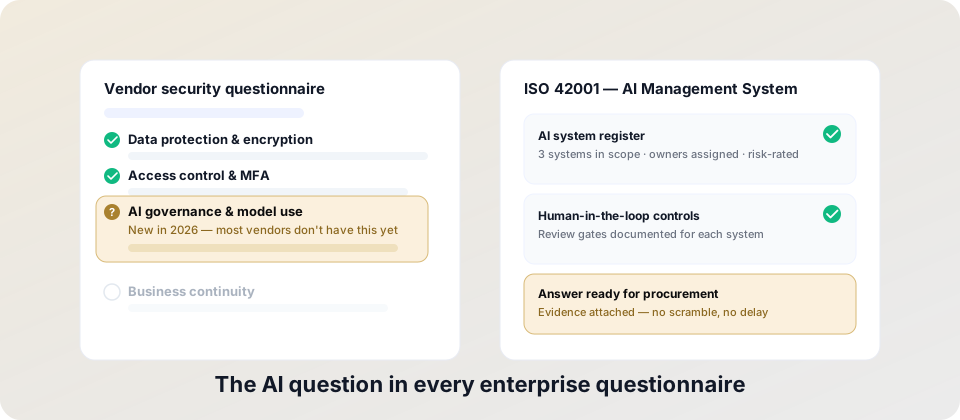
The question isn’t usually technical. It’s something like: “Can you provide evidence of your ISO 27001 certification?” or “What is your Essential Eight maturity level?” or “How do you govern the AI systems in your product?”
Most growing businesses don’t have a clean answer ready. They scramble. Deals stall. Procurement moves to the next vendor.
This post is about why that happens, what enterprise buyers are actually looking for, and how to turn compliance from a blocker into one of the sharpest edges in your sales process.
Why enterprise procurement has changed
A decade ago, enterprise procurement security reviews were largely tick-box exercises. Send us your policy. Sign our questionnaire. Done.
That era is over. After a string of high-profile supply chain incidents — SolarWinds, Log4j, MOVEit — enterprise security teams have raised their vendor bar materially. They’re not just asking whether you have policies. They’re asking whether controls actually work, whether evidence is auditable, and whether a breach in your environment could cascade into theirs.
What enterprise buyers are actually looking for
Before getting to the fears, it helps to understand what’s on the other side of the procurement table. Enterprise security teams aren’t trying to achieve perfection — they’re trying to answer three questions:
Not perfect — credible. ISO 27001 or Essential Eight ML2 signals systematic thinking, not just a written policy.
Self-attestation has almost no value. They want auditable evidence — configuration exports, access logs, penetration test reports.
CISOs are personally accountable for vendor decisions. A clean ISO 27001 cert makes that defensible. A self-assessed questionnaire doesn't.
With that context, here are the three fears — and what to do about each.
Fear 1: Timelines that stall deals in procurement limbo
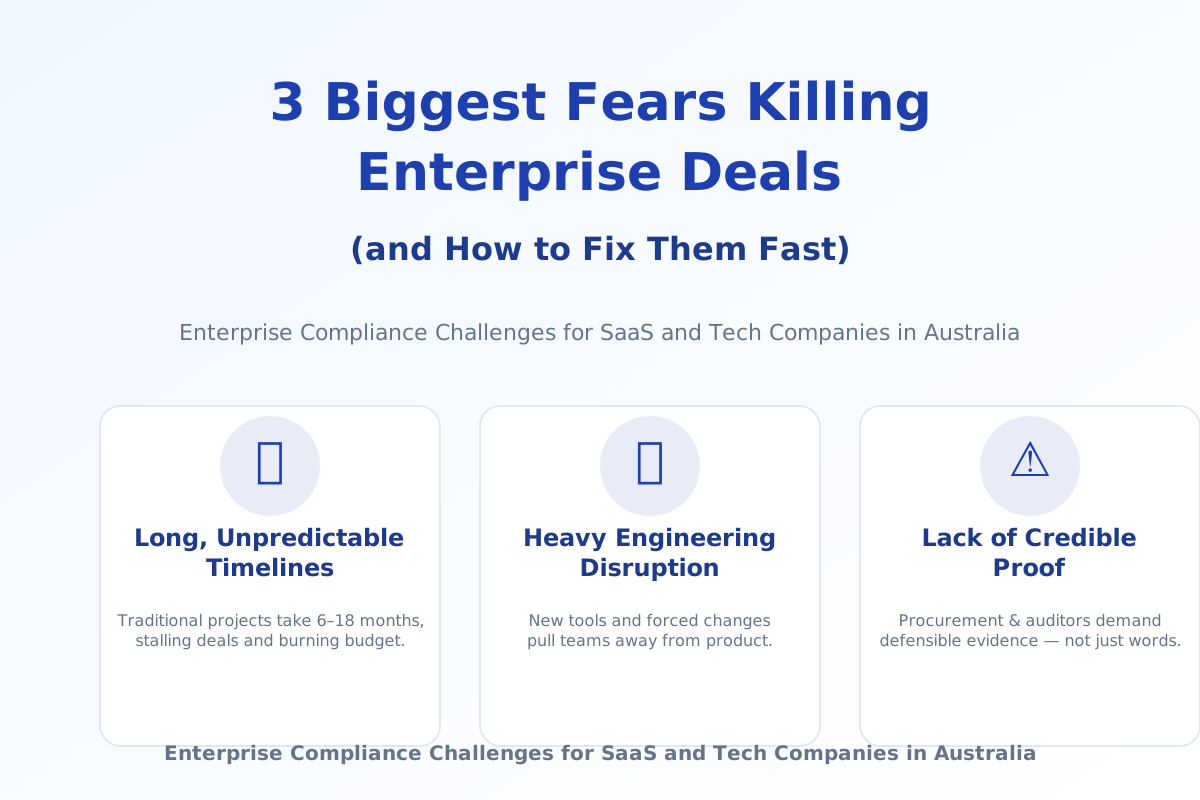
The sales team lands a serious enterprise prospect. Procurement asks for ISO 27001 certification as a contract condition. The CTO gets quotes: $150,000–$300,000 and 12–18 months. The deal dies — or gets a temporary waiver that expires and comes back as someone else’s problem six months later.
The long timeline comes from three compounding problems:
- Unnecessary scope — treating every Annex A control as mandatory regardless of your actual risk profile
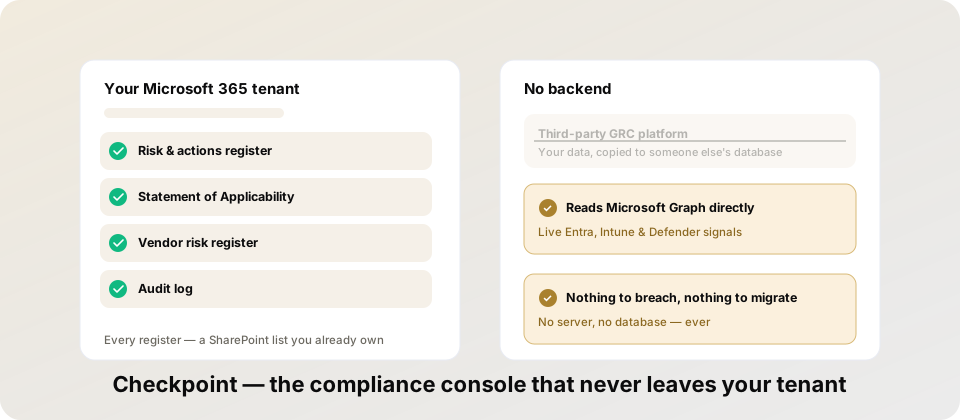
- New tooling — insisting on a third-party GRC platform and separate risk tools instead of building inside the environment you already operate
- Junior delivery — a partner sells the engagement and juniors deliver it, so work moves at the pace of the least experienced person on the team
Fear 2: Compliance will disrupt engineering and slow the product
A CTO who has spent years building a lean, fast-moving team knows exactly what “compliance project” usually means: months of meetings, a new mandatory tool, policies requiring sign-off from people who are busy shipping features, and a consultant who needs walking through the architecture repeatedly.
The fear is not irrational. Many compliance programmes are genuinely disruptive — they consume senior engineer time, introduce tooling debt, and produce documentation that does not reflect how the system actually works.
What zero-disruption compliance looks like in practice — inside Microsoft 365:
- MFA enforcement via Conditional Access — not a new identity platform
- Vulnerability management via Defender for Endpoint — not a separate scanning tool
- Evidence collection via SharePoint and Power Automate — not a GRC subscription
- Policy management in SharePoint with version control — not a dedicated policy platform
- Risk register in SharePoint or your existing project management tool — not a separate risk system
Fear 3: Evidence that doesn’t survive scrutiny when procurement asks
The security questionnaire arrives. Your team fills it in — mostly “yes”, a few “partial”. You attach the information security policy and send it back.
Two weeks later: “Thank you. We have follow-up questions. Can you provide evidence that MFA is enforced for all users accessing production systems? Can you share your most recent penetration test report? Can you provide access review records for the past 12 months?”
Your team scrambles. Someone takes screenshots from the Entra admin portal. Someone else hunts for a penetration test report from 18 months ago. The access review records are in a spreadsheet someone maintains manually. The follow-up takes three weeks. By then, the prospect’s evaluation window has closed.
For each control, defensible evidence needs three properties:
Timestamped — the configuration export was generated on a specific date, by a specific person, from a specific system. Not a screenshot of uncertain provenance.
Attributed — there is a clear owner for the control, accountable for maintaining and reviewing it. Evidence without attribution looks like it was produced for the audit, not as part of ongoing operations.
Connected to a risk — the best evidence packs show not just that a control exists, but why it exists. The access review happens because the risk register identifies unauthorised access as a risk to treat. This narrative is what transforms a folder of screenshots into a credible ISMS.
How compliance becomes a competitive advantage
When you can answer a procurement security questionnaire in hours rather than weeks, you move faster than competitors who cannot. When you send a structured evidence pack with timestamped exports and clear ownership, you look materially more credible than vendors who send a self-assessed questionnaire. When you hold ISO 27001 or Essential Eight ML2 and your competitors are still working on it, the procurement decision is not really a decision.
Answer procurement questionnaires in hours. Move faster than competitors who cannot.
Structured evidence with timestamped exports looks materially stronger than a self-assessed questionnaire.
When you hold ISO 27001 or Essential Eight ML2 and competitors don't, the procurement decision is clear.
Evidence built once answers every procurement question, every renewal, every customer due diligence review.
The companies that treat compliance as a revenue driver — not a cost of doing business — get on approved vendor lists faster, win enterprise deals competitors are not even considered for, and close more quickly because procurement gates do not slow them down.
Where to start
Most organisations find that 60–70% of what they need for ISO 27001 or Essential Eight is already in place. What is missing is usually documentation, evidence structure, and a handful of specific controls — not a ground-up rebuild.
Use our free readiness checklist to get a baseline picture in about 15 minutes. Or book a free 30-minute call — we will tell you honestly what you need and what the fastest path looks like for your specific environment.
We deliver ISO 27001, Essential Eight, SOC 2, ISO 42001, and ISO 27701 for Australian mid-market organisations — fixed-price, inside your existing Microsoft 365 environment, with audit-ready evidence at every step. Explore our services →
Found this useful? Get the ISO/Privacy/AI readiness checklists.
Browse resources